

Extraordinary Maintenance, Conservation and Restoration Work on Selected Works for the Exhibition “Bernardino Luini e i suoi figli” (“Bernardino Luini and His Sons”) at Palazzo Reale, Milan, 1
WORK
1 oil on canvas, 1 oil on panel, 2 detached frescoes, 1 missal
ARTIST
Workshop of Bernardino Luini
DATE
16th century
Project Period
2014 – in the months before the exhibition
bernardino luini and His Sons
The Paintings and Mixed-Media Objects Conservation and Restoration Laboratory was commissioned to carry out extraordinary maintenance and restoration on five works in preparation for the exhibition Bernardino Luini e i suoi figli (“Bernardino Luini and His Sons”), held at Palazzo Reale in spring 2014. One of the works, the cover of a missal, was conserved in collaboration with the Textile Restoration Laboratory.
The most complex restoration treatments concerned a large canvas painted by Bernardino’s son, Aurelio Luini, and the cover of an exquisitely refined sixteenth-century missal.
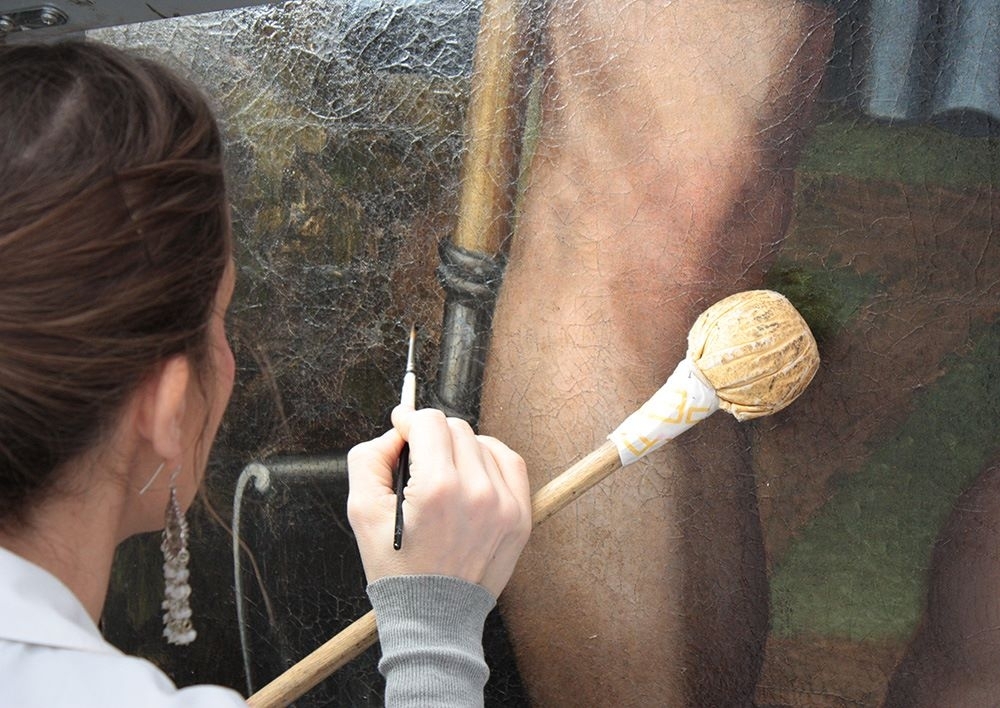
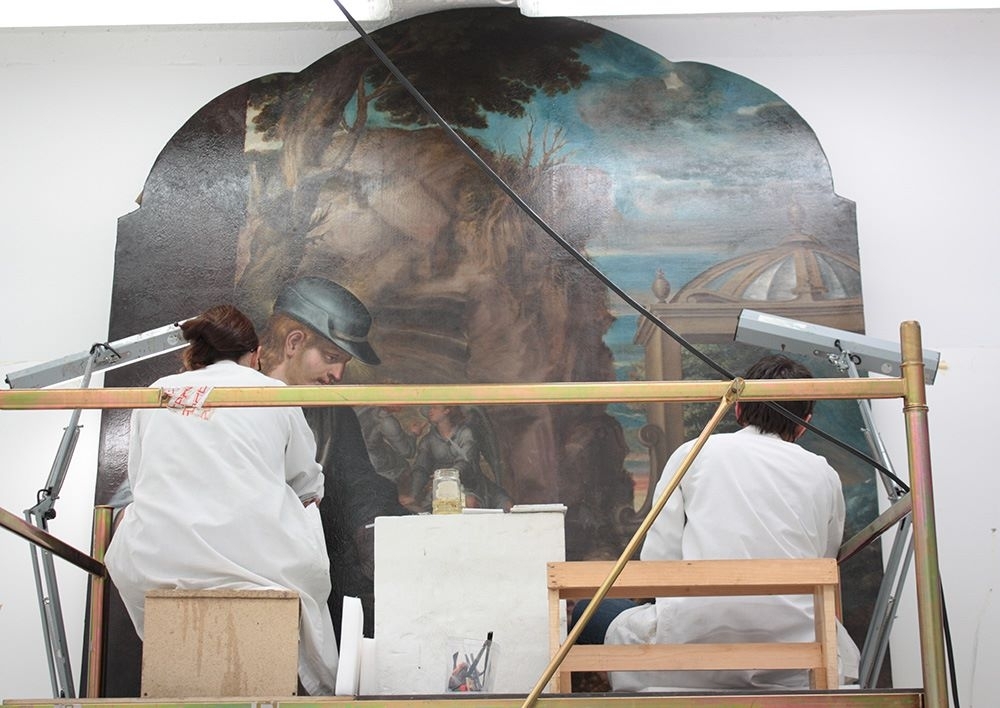
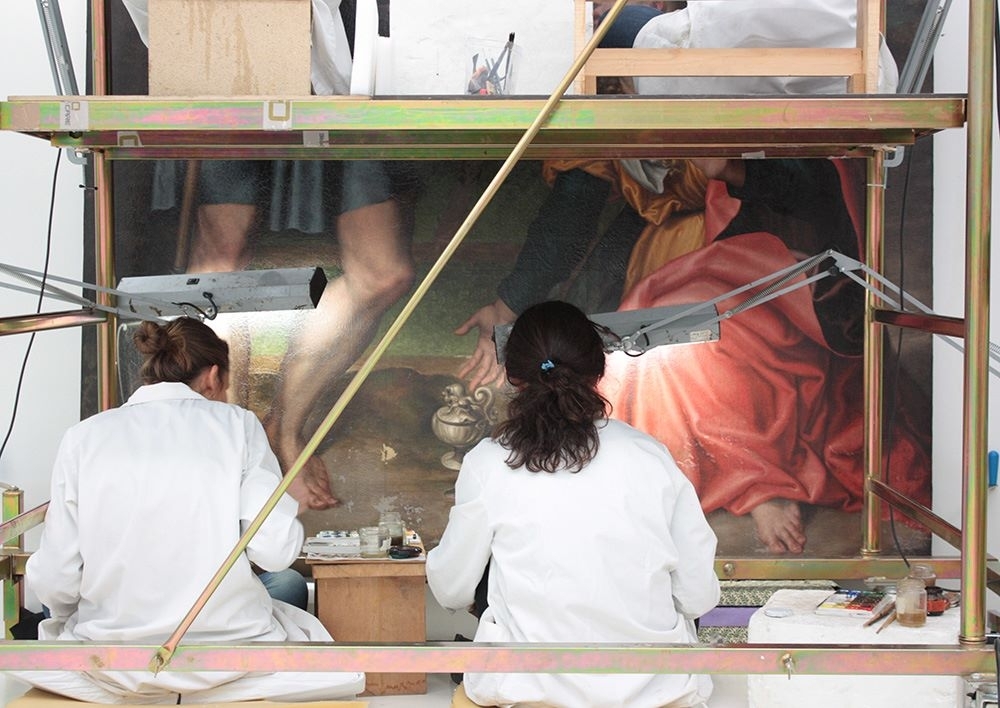
The work Noli me tangere (oil on canvas, 1581–1587) by Aurelio Luini, from the Parish of San Tomaso in Terramara in Milan, underwent a restoration in several phases: from the consolidation of the textile support and the mending of the threads along the edge-to-edge tears, to re-tensioning on the stretcher, which was made expandable through a lengthy restoration.
The paint film, darkened by the thick layer of dust deposited over time and by the oxidation of the already tinted varnish applied in earlier restorations, was consolidated with a low-pressure treatment carried out on the table, which nevertheless avoided flattening the thickness of the paint matter and the dense cup-shaped craquelure.
The restoration ended with the patient workof filling the various losses, retouching in watercolor and glazing with varnish colors.
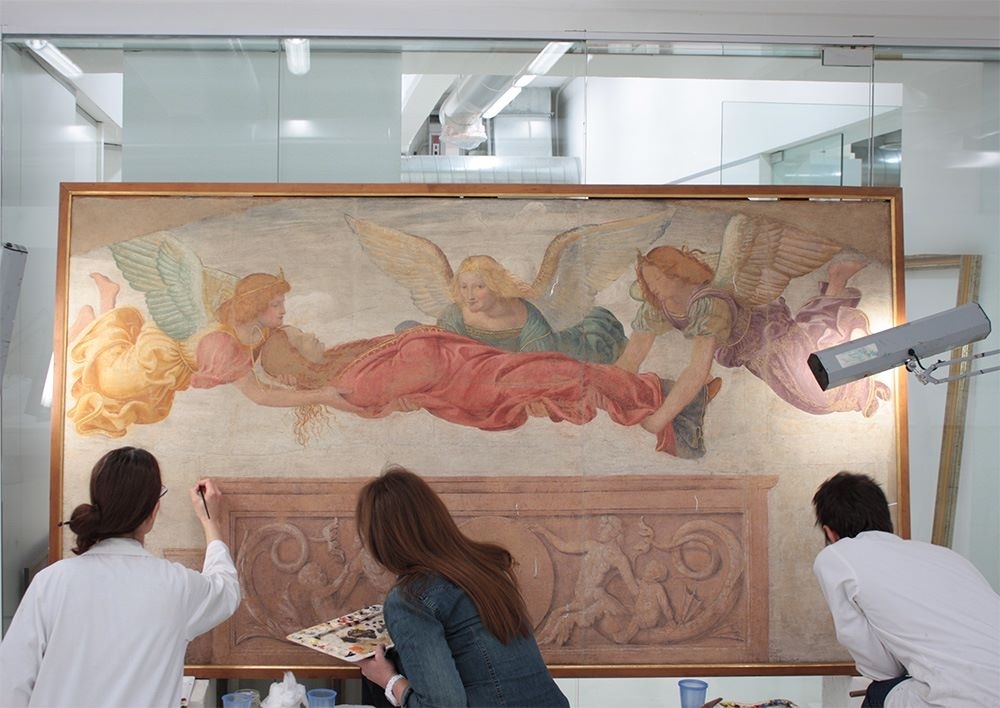
Extraordinary maintenance was instead carried out on three detached frescoes by Bernardino Luini (A Family of Satyrs Making a Sacrifice to Pan, c. 1514; Putto Harvesting Grapes, c. 1514; The Body of Saint Catherine of Alexandria Carried by Angels, c. 1514) from the Villa della Pelucca in Sesto San Giovanni, and on the wonderful panel Madonna of the Veil, c. 1505–1510, by Ambrogio da Fossano, known as Il Bergognone, all belonging to the Pinacoteca di Brera.
In addition to the paintings, also for the exhibition, the cover of a printed paper volume dated 1594 was conserved. The book is sewn on four leather cords, with headbands decorated in two colors, and is on deposit at the Museo Diocesano in Milan. The boards are of wood; the cover, the element on which Open Care worked, is in fabric with silver clasps. The cloth of gold is richly and finely embroidered with gold and silver threads, polychrome silk threads, bullion wire (canutiglia), freshwater pearls, and there are eight bookmarks in polychrome silk. The missal has until now been attributed to one of the finest embroidery workshops of Milan at the time, the Delfinoni or the Pusterla, probably after a design by Luini. The treatment carried out on the work for the exhibition involved removing the substantial deposits of dust and organic matter from the surface through a lengthy micro-suction of the threads, which brought the gold, the pearls and the colors back to full legibility. This was followed by the consolidation of the losses by stitching onto silk supports, the reapplication of the embroidery threads and, finally, the cleaning, flattening and protection of the bookmarks.